Support
Part of Small office IT support
Comparing ad hoc support with a managed support agreement
Compare ad hoc IT help with a managed support agreement using scope, costs, response terms, security and day-to-day coordination.
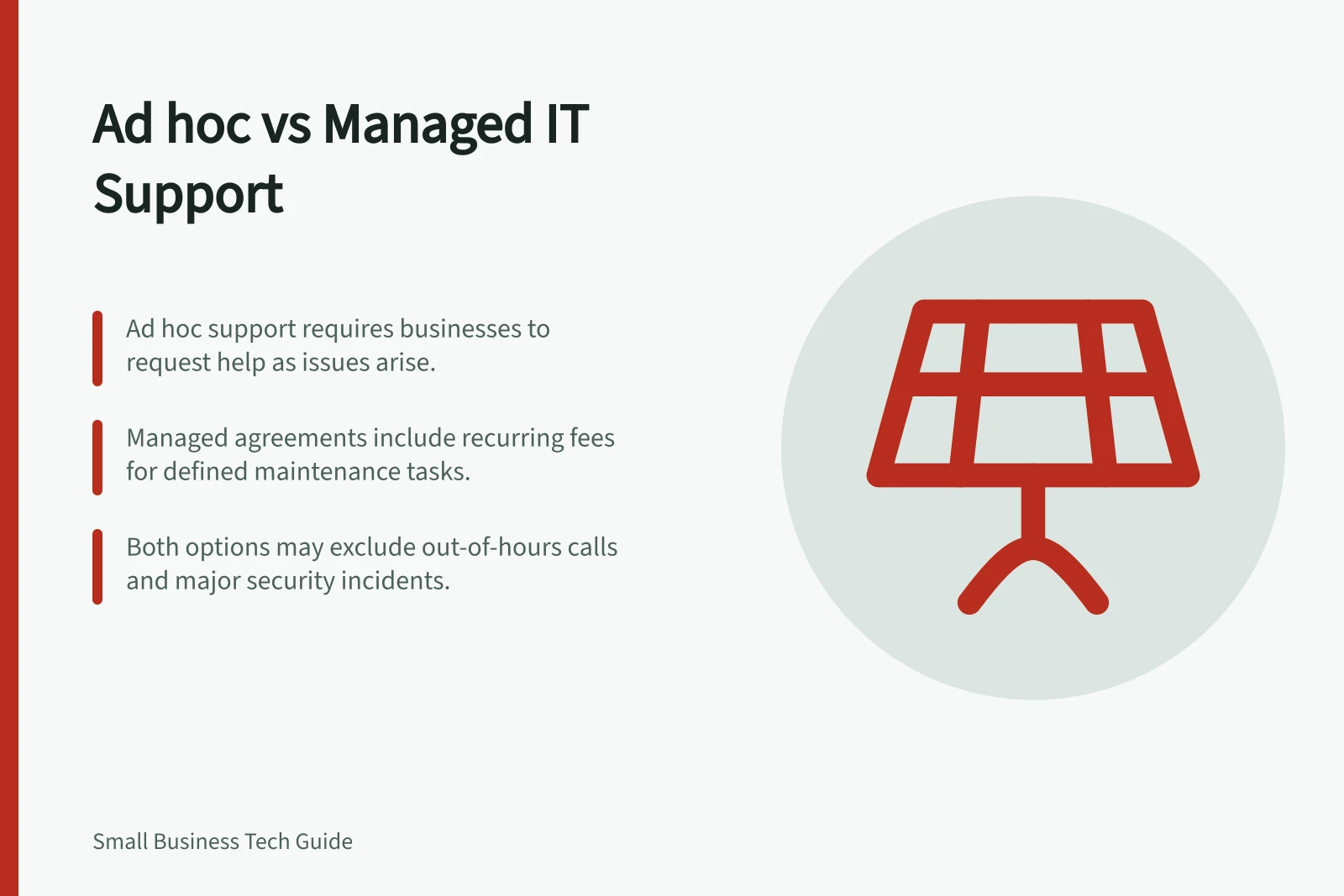
Choose ad hoc IT support if the office can arrange help as problems arise and coordinate its suppliers. Consider a managed agreement if it needs continuing support or maintenance for defined systems. Compare the proposed terms: neither label promises every repair, security task or out-of-hours call.
Pros and cons of ad hoc vs managed IT support
- Ad hoc support – Pros
- Lower upfront costs; flexibility to choose help only when needed.
- Ad hoc support – Cons
- No guaranteed response time; coordination burden on the business.
- Managed agreement – Pros
- Predictable costs; dedicated support owner; proactive maintenance.
- Managed agreement – Cons
- Recurring fees even if no issues arise; potential for hidden charges.
Compare the work and the cost
List the faults the office has had and the routine work it needs even when nobody reports a problem. Ask prospective providers to describe and price the same work.
| Decision point | Ad hoc support | Managed agreement |
|---|---|---|
| Starting work | The business requests a job under agreed terms. | Covered work follows the agreement's contact and maintenance process. |
| Charges | Costs depend on the work ordered and the quoted terms. | A recurring fee may cover defined work; exclusions may cost extra. |
| Coordination | The business may need to track jobs and supplier hand-offs. | Coordination can be assigned to the provider if the agreement says so. |
| Useful fit | Occasional, contained issues. | Continuing administration and support that need a clear owner. |
These are possible arrangements, not standard inclusions. An ad hoc provider may offer a rapid response option; a retainer may cover only narrow tasks.
Check the written boundaries
Ask which users, devices, sites and services are covered. Check business hours, contact methods, response targets, on-site visits, travel, parts, project work and third-party software. A response target usually concerns the initial response; ask separately how updates and resolution are handled. Confirm who coordinates a major outage with an internet or software supplier.
For managed support, ask which maintenance tasks are included, how changes are approved and what reports or documentation the business receives. Check how records and access are returned or removed when the agreement ends. For ad hoc support, ask how the provider retains enough context to handle a later request efficiently.
Ask separate security questions
An external technician may need privileged access. Ask how the provider controls access, records administrative work and reports an incident affecting its access or your systems.
Do not assume routine helpdesk cover includes cyber investigation, data recovery or after-hours containment. Check the proposed scope and escalation arrangements.
Security considerations for IT support providers
- Privileged access control
- Ask how access is granted, monitored and revoked.
- Incident reporting
- Confirm how breaches or suspicious activity are reported.
- After-hours containment
- Check if this is included in standard service levels.
- Data recovery capability
- Verify if recovery is part of the support scope.
Test the proposal against a scenario
Describe the same hypothetical morning to each candidate: several staff cannot use a shared application, and one worker has a separate laptop fault. Ask who takes the first call, what is covered, what costs extra and when the office receives an update. Compare the answers with the disruption the office can tolerate.
If faults are rare, a documented ad hoc arrangement may be enough. If recurring faults and routine administration lack an owner, price a managed scope against those specific needs.